
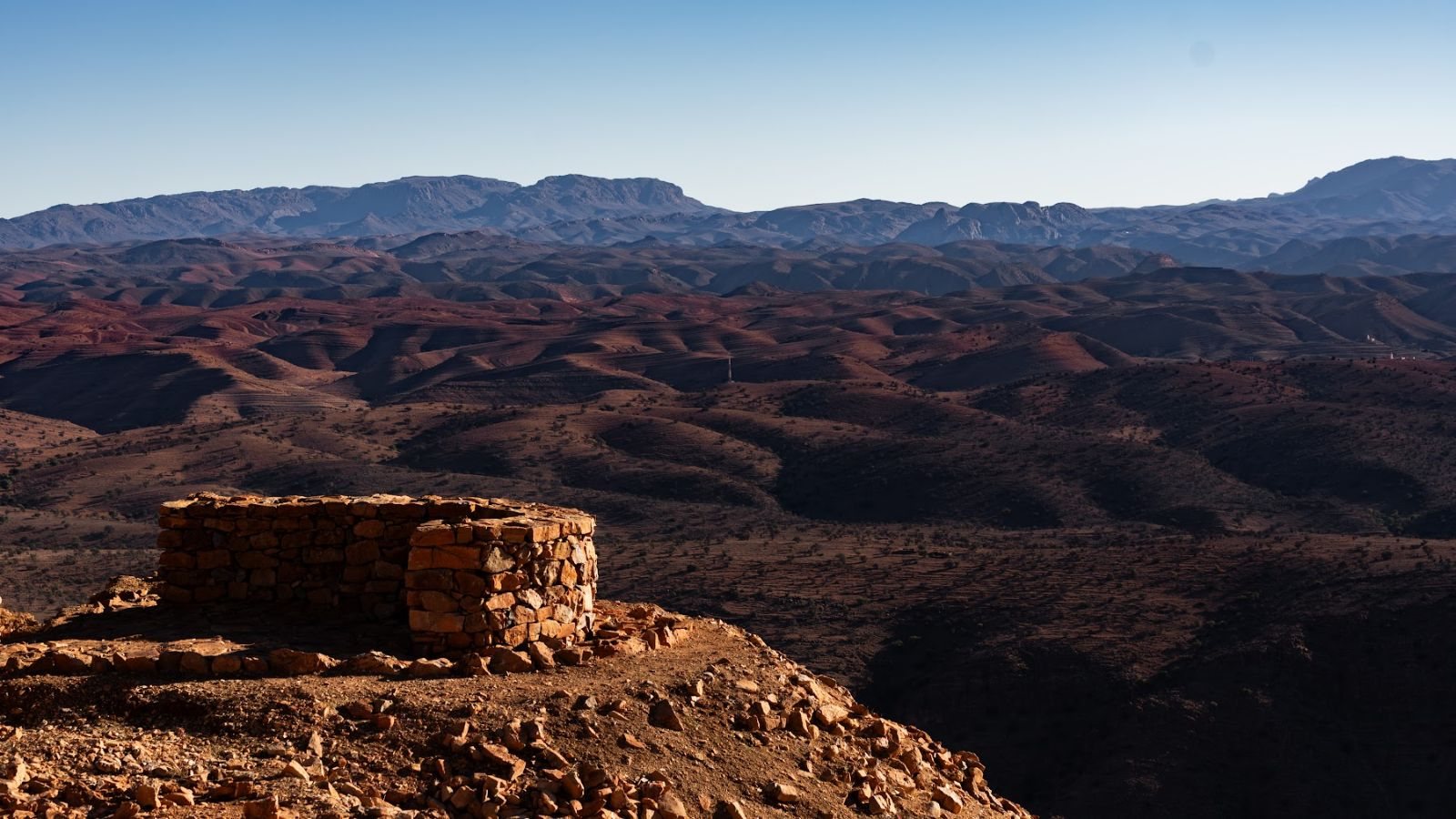
The Spark of Igiliz: The Mountain Where the Almohads Began
An Idea on a Mountaintop
Can an idea born in the mountains shake the throne of an entire empire? High in the Atlas, on a rocky summit called Igiliz, a new chapter of Moroccan history began in a place with no palaces and no armies. It had no state and no resources. It had an idea, and that was enough to change the balance of power.
Many Moroccans have driven past these mountains and admired their colours and their silence. As a child, Zakaria found them frightening: huge, ancient and full of mystery. Standing among them now, he asks who walked here a thousand years ago, how they lived, and what they believed.
In the fourth episode of Turath Ummati, we climb to Igiliz to meet one of them: a man most Moroccans have heard of, but few really know.
A Giant at Its Height
In the early 12th century, the Almoravid state was one of the great powers of the Islamic world. It had stood up to the Christian kingdoms of the north and restored the balance in Andalusia. Its rule stretched from the Ebro valley to the Sahara, and from the Atlantic to the edges of Bejaia: more than 3,000 kilometres from north to south.
It linked great cities such as Sijilmasa, Aghmat, Fez, Tlemcen, Cordoba and Seville. It was proof of how simple Amazigh tribes from the desert could become a political giant.
So the question the episode asks is simple: how could a giant like this fall? And who could possibly bring it down?
A Scholar With a Hard Temper
Mohammed ibn Abdallah, later known as Ibn Tumart, was born around 1080 into the Masmuda tribes, between Taroudant and Tizi n'Test. He grew up in a religious home and loved learning from an early age.
Around 1106 he set off on a long journey in search of knowledge: Cordoba, Alexandria, Mecca, and then Baghdad, where he spent years among scholars of many schools of thought. When he returned to the Maghreb, Ibn Khaldun described him as a sea of knowledge and a flame of faith.
But he had one flaw, which even his admirers noted: he was harsh and uncompromising, and he wanted to change everything at once. On the voyage home, his preaching angered the passengers so much that they threw him into the sea. On the way, he also met a young man named Abd al-Mu'min, who would become his student, his companion and, one day, much more.
Showdown in Marrakesh
Back in Marrakesh, Ibn Tumart saw what he considered corruption everywhere in the Almoravid capital. He refused the patient path of reform that Abdullah ibn Yasin had followed a century earlier. He wanted to overturn the system itself.
One day, he struck the horse of a woman riding through the city with her face uncovered. She turned out to be the sister of the Almoravid emir, Ali ibn Yusuf ibn Tashfin. Soon after, the two men came face to face at the Ben Youssef mosque after Friday prayer.
What followed was a public debate with the empire's greatest scholars that left the emir in tears, a secret warning that would prove prophetic, and a decision that changed the course of history. The episode tells it in full, filmed in the heart of the old medina.
Igiliz: A Zawiya on the Summit
Forced out of Marrakesh, Ibn Tumart moved from tribe to tribe, escaping every attempt to capture him. He returned to the land of his birth and climbed to Igiliz, where he founded a zawiya high in the Atlas: a centre for teaching, spiritual training and organisation.
The episode walks through the ruins: the small retreat rooms used for meditation, the prayer hall where even the rows followed a strict hierarchy, and the open courtyard where he addressed his followers. These walls are about 900 years old and very fragile. If you visit, please respect them: take nothing, and never climb on them.
It was here that Ibn Tumart made the most dangerous announcement of his life, one that turned a movement of scholars into a revolution. What he claimed, and what it cost, is at the centre of the episode.
From Bloodshed to Civilisation
The movement grew until Igiliz was too small for it, and it moved to Tinmel. Its followers took the name al-Muwahhidun, the Almohads, from Ibn Tumart's call to tawhid, the oneness of God. What happened when they finally faced the Almoravid army, and who took the lead after Ibn Tumart, is told in the episode.
The beginning was violent. But the Almohads also left Morocco some of its greatest monuments, including the Koutoubia mosque in Marrakesh, the Hassan mosque and Bab Rouah in Rabat, and the Kasbah of the Oudayas. Their era also produced thinkers who shaped the world, among them Ibn Rushd, Ibn Tufayl and Maimonides.
The episode was screened at Cinema Sahara in Agadir to a warm reception. Watch it on Turath Ummati to hear the full story of an idea born on a forgotten summit in the Atlas.