
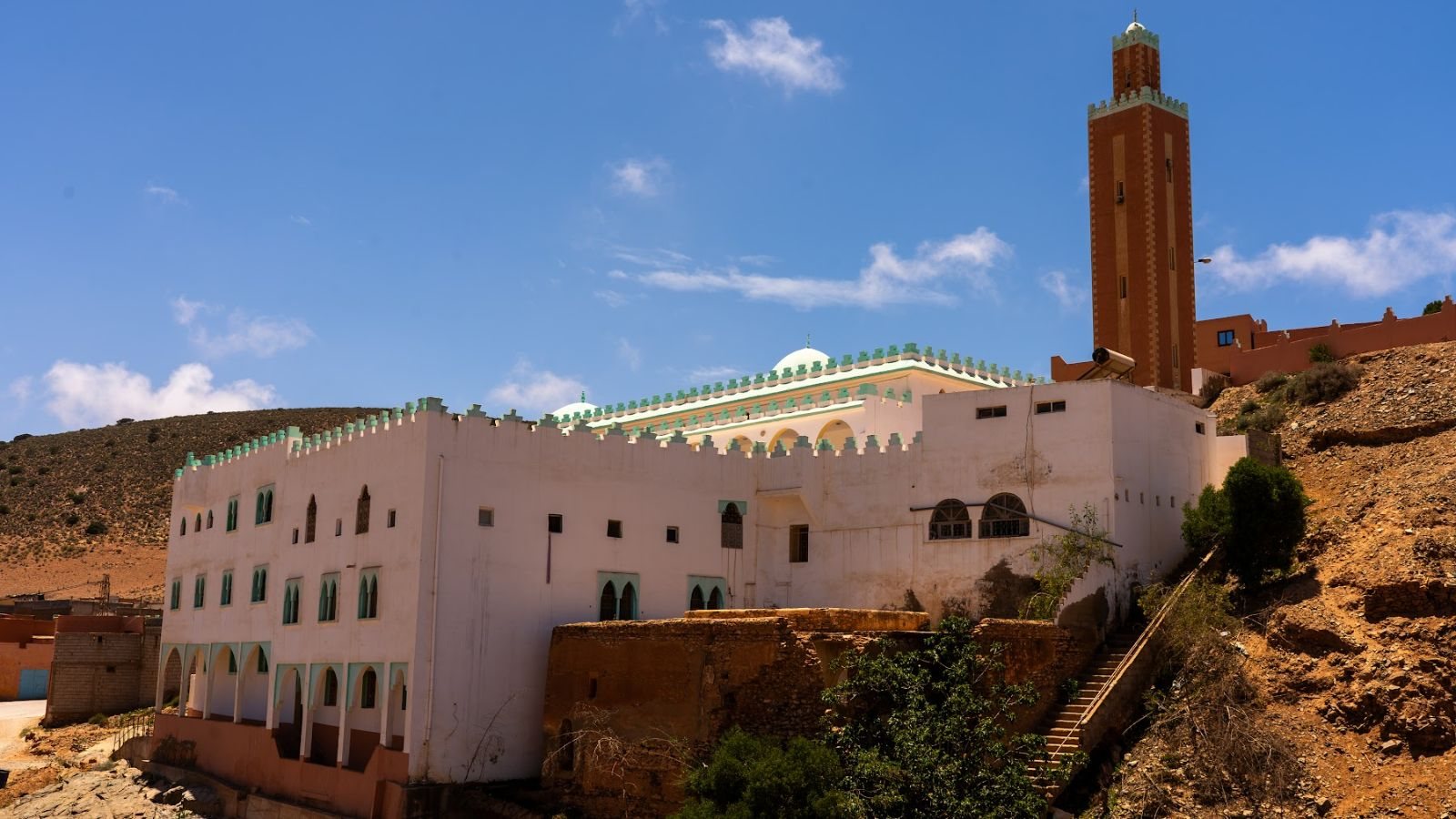
Zawiya Waggag: The Village School That Built an Empire
What Can a Teacher and Seven Students Do?
Every summer, crowds head to Aglou beach near Tiznit to escape the heat. Few of them know that a short drive inland, in a small village among the hills of Sous, stands a building that changed the history of Morocco.
It is not a palace, and it never housed an army. It is a zawiya, a place of learning. Yet the men raised here went on to found a state that stretched from the Senegal River to Andalusia: the Almoravids.
In the first episode of Turath Ummati, we visit the place where that story began.
The Teacher: Waggag ibn Zallu
Around a thousand years ago, in the 11th century, a scholar from the Lamta tribe named Waggag ibn Zallu al-Lamti founded a zawiya in Aglou. He was a Sufi, a scholar and an educator. He did not build it for fame, but to teach, to guide and to raise people well.
Students came from every corner of Sous, and from further still, to learn from him. One of them was a young man named Abdullah ibn Yasin.
The Student: Abdullah ibn Yasin
When Abdullah ibn Yasin finished his studies, he looked at the country around him and did not like what he saw. Everyone was Muslim, but each person understood the religion in his own way. He decided that something serious had to be done.
So, like his teacher before him, he headed south and started from nothing. He founded a small zawiya of his own with just seven men. Those seven became seventy, then hundreds, then thousands.
Among those first seven were two brothers from the Sanhaja tribe. What they built, and how it led to the founding of Marrakesh and the rise of Yusuf ibn Tashfin, is the heart of the episode.
A University Before Universities
When people hear "traditional school", many picture an imam with a long stick and frightened children. The episode argues that the real picture is very different.
The traditional schools of Morocco and Andalusia were the backbone of education for centuries. Scholars such as Ibn Rushd, Ibn Tufayl, Ibn Hazm, Ibn Battuta and al-Idrisi came out of this system. Children started at five, and they were taught to understand, question and debate, not only to memorize.
There were no desks, no blackboards, no chalk. Students sat on the floor in circles, each circle studying a different subject, and they could move between them freely. They slept, ate, studied and worked in the zawiya: a complete way of life.
The system lasted for centuries, until the colonial era. Why it was targeted, and what that tells us about learning today, is one of the episode's most thought-provoking moments.
Still Alive Today
Does anyone still study at the zawiya? Yes. It still welcomes students who live and learn there in the traditional way, and the villagers of Aglou still bring food to the imam, one family at a time.
The zawiya no longer has the influence it once had. But people still care for it, and they have not let it die. Our heritage is not only in books; it is alive in places many of us have forgotten.
Watch the full episode of Turath Ummati to step inside the zawiya and hear the rest of the story.